Power in Numbers

Teachers like to be in control.  And because of that character trait, we like to talk a lot.  We have so much to share.  But, are we making sure that students are having multiple opportunities to talk about the content they are learning?  There is a quote that I’ve heard many times in the world of education, “The person doing the most talking is doing the most learning.”

So, how do we step back and allow students to take control?  One way is through flexible groupings.  Pairs, triads, random and assigned.  Based on readiness, mixed readiness, interest, or learning preference.

21st century skills highlight collaboration, critical thinking, communication, and problem solving.  What better way to practice those skills than in groups?

In the 1990’s, Spencer Kagan came up with a vast array of structures for cooperative learning in small groups.  These structures are just as powerful today as they were almost 20 years ago.

Some of my favorites are:

  • think-pair-share
  • jigsaw
  • inside-outside circles
  • placemat
  • four corners
  • talking chips

As far as grouping strategies, some of my favorites are clock buddies and grouping cards.  Here’s a set of 36 cards that have a multitude of uses:

GROUPINGS_NTO

For more resources on the topic of flexible grouping and grouping strategies, go to:

http://letsgetengaged.wikispaces.com/The+Power+of+Us
 

Screen shot 2013-04-14 at 8.45.31 PM

Happy Grouping!


I’m so much more than a test score!

As Student Growth is becoming a pivotal part of teacher evaluation, teachers need to become data experts.  Baseline data, formative assessments, and artifacts and evidence will be central to measuring student learning.  Standardized and district-created tests yield data that can be sorted and separated.  Teachers collect daily data from students in the form of student work, exit tickets, and observation.  For some great ideas for formative assessment strategies, visit this link.

So, the question is… do all of those data points paint a complete picture of who your learners are?  I think not.  There is so much more to know about our students beyond just test scores.  What are some ways you can collect data about student interests and learning preferences?

I’ve assembled a variety of resources on the topic of Knowing Your Learners on my wiki called Dare to Differentiate.  There are many tools that have been created, both low and high tech to collect information about our learners in terms of their interests and learning preferences which are customized to the age/grade level of the students.  There are even multiple intelligence and learning styles surveys that can be administered to World Language students in the target language.

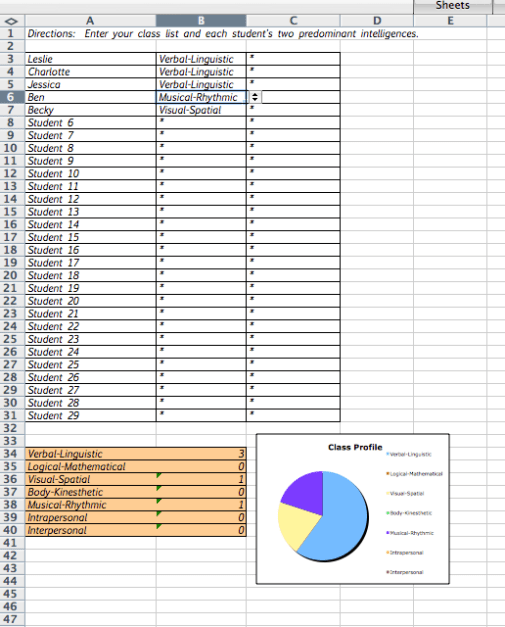
Two of my favorite tools were developed by a colleague.  The first, “Where Does Your Intelligence Lie?,” is an Xcel worksheet on which students indicate True or False to a series of statements.  Once you have the student data, you use the second tool, “Class Intelligence Profile,” where you input the two strongest intelligences for each student in a particular class.  The results are then created in a chart and also in the form of a pie graph.

Many teachers with whom I have worked love this tool!  They print out the pie graph for each class and keep it in their plan books.  As they plan lessons for their classes, they refer to the graph to align activities they are planning with the students’ intelligences.

Image   Image

Another great resource I’ve found recently is called a “personality array.”  You compare your personality with the characters from Winnie the Pooh.

Image

Happy data collecting!