Increasing student confidence and comfort with interpersonal speaking

In her TED Talk entitled “Can Gen Z reclaim the art of conversation?,” Dr. Michelle Burke shares her insights from twenty years of classroom experience on the decline of the ability of Gen Z students to converse and build social connections. They lack skills such as making eye contact, reading facial expressions, and interacting authentically.

Language educators are experiencing the same phenomena in their classrooms. Students feel reluctant and unsure about participating in interpersonal interactions in the target language.

How can will help our language learners increase their confidence and comfort to communicate interpersonally?

Design supported, low stress interpersonal tasks that ensure success

In order for our novice learners to confidently interact and negotiate meaning in the target language, they need interpersonal practice every class meeting, in short spurts, and in low stress, low risk, and low stakes situations.

Let’s begin with the following strategies:
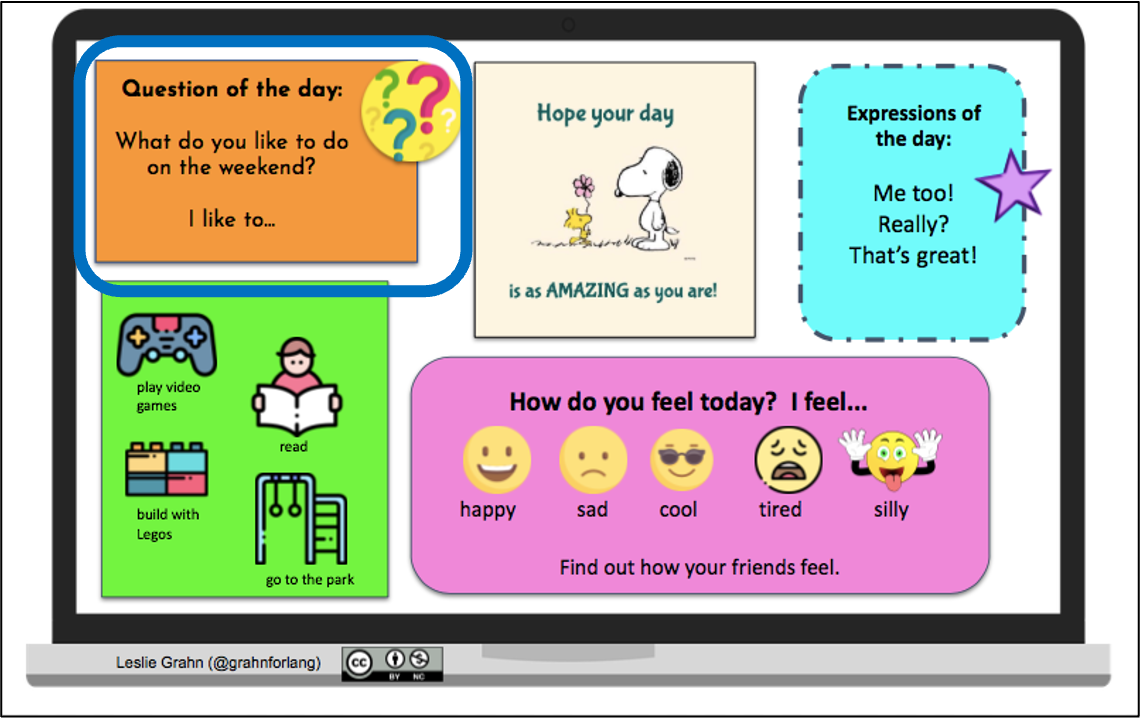
  1. One way to build student confidence in participating in interpersonal speaking is to begin every lesson with a “turn and talk” task as part of the opening routine. Provide students with a prompt such as a “question of the day” which they use as a conversation starter with a classmate.
Similarly, students may conduct an interpersonal exchange through a daily Social Emotional Learning (SEL) check-in.
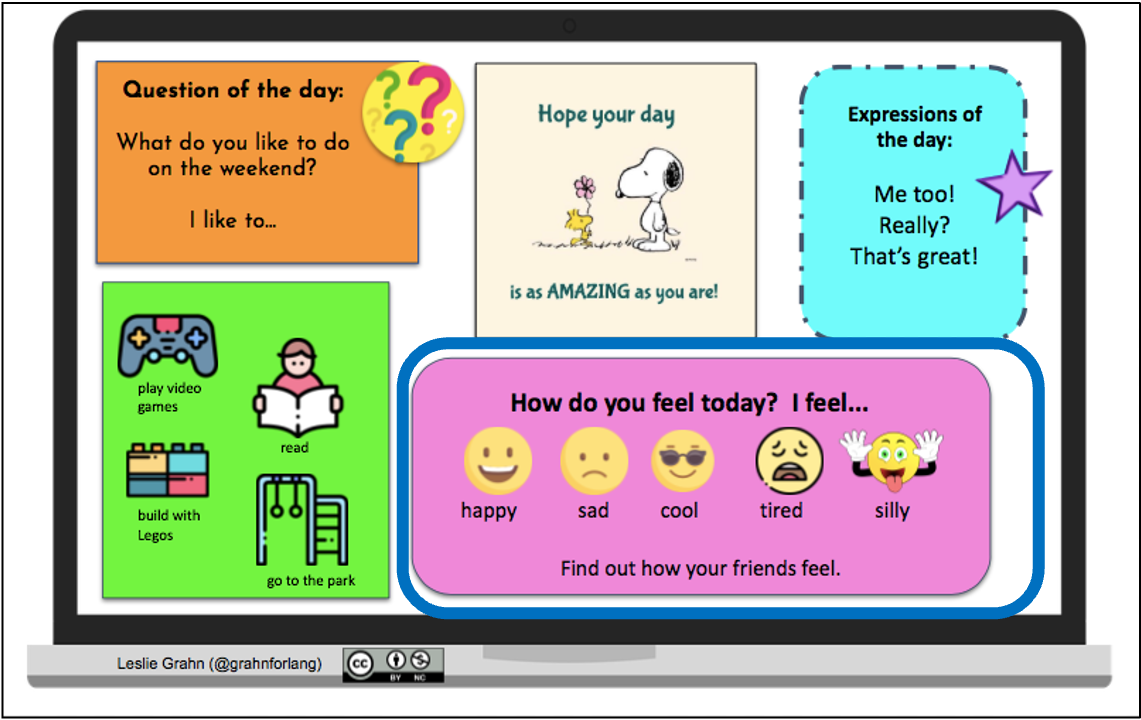
Looking for ideas for SEL check-ins? Check out this Pinterest board: https://www.pinterest.com/grahnforlang/social-and-emotional-learning/check-ins-on-a-scale-of-this-or-that-would-you-rat/

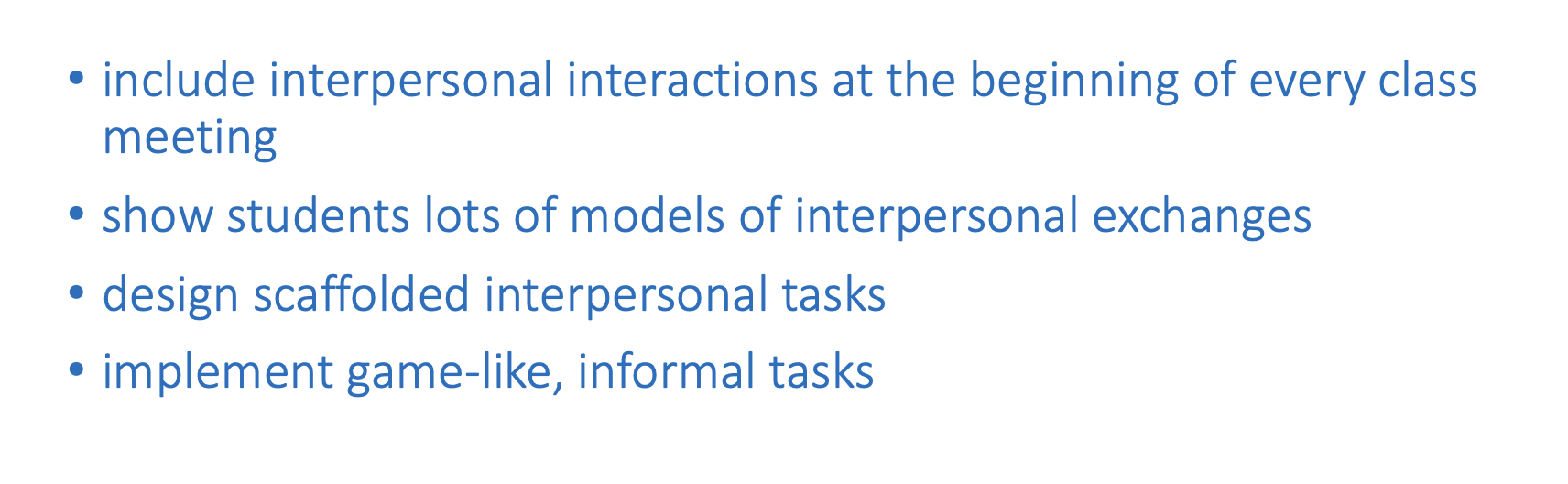
2. Another way to build confidence, is to show students lots of models of interpersonal exchanges, through live or recorded interactions. Some examples of sources for such exchanges include:

Audio Lingua (in 14 different languages)Dialogues in Spanish with audio
French Speaking Practice on TikTokItalian Conversations YouTube
ASL Conversations (YouTube)Chinese Conversation Clips (YouTube)

As students listen to interpersonal conversations in the target language, they can use organizers like this one from Kylie’s Corner on TPT which is FREE! (https://www.teacherspayteachers.com/FreeDownload/EDITABLE-Speech-Bubbles-4860879)
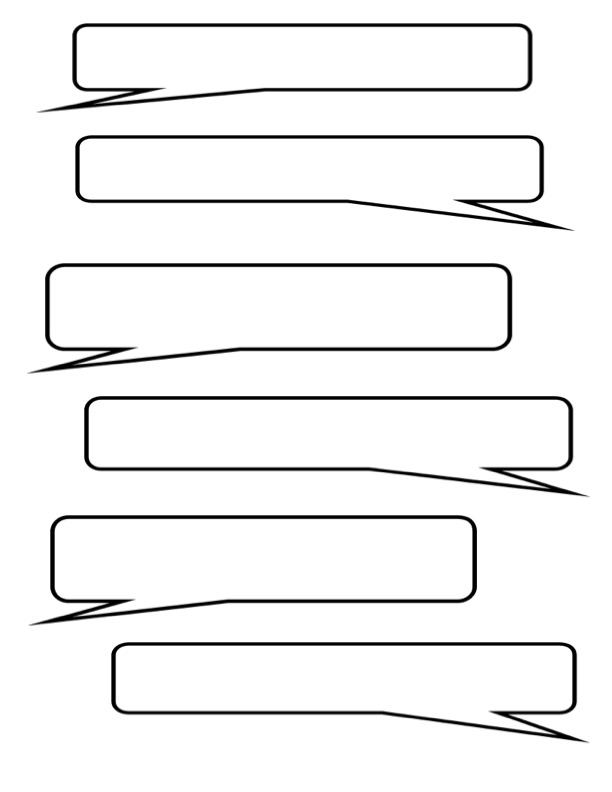
Students record what they hear either by scripting the entire conversation or by listing questions, responses, reaction phrases, etc. Students can also critique the interaction by suggesting ways the interlocutors could have improved the exchange. If the interpersonal models are via video, teachers may lead a class discussion about cultural products, practices, and/or perspectives that are evident.

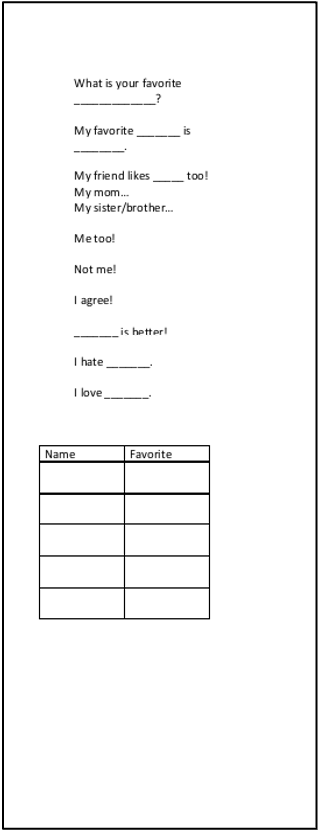
3. Designing scaffolded interpersonal tasks is an additional confidence-building tactic. Expression lists, sentence starters, charts, and graphic organizers can be added as scaffolds to tasks. Here is an example of a scaffolded interpersonal task from a unit on free time activities and hobbies using the inside-outside circle strategy.
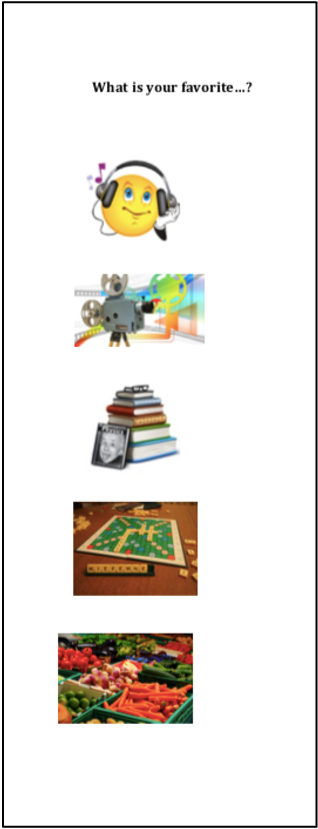
On the front of the card, students have a series of images that relate to categories of their favorite things. As they move from talk partner to talk partner, they ask and answer the question: “What’s your favorite _____?” (ex. music, movie, book, game, food).

On the back of the card, there are sentence starters and communicative fillers to support students in their interactions. In addition, there is a T-chart where students record their classmates’ responses.

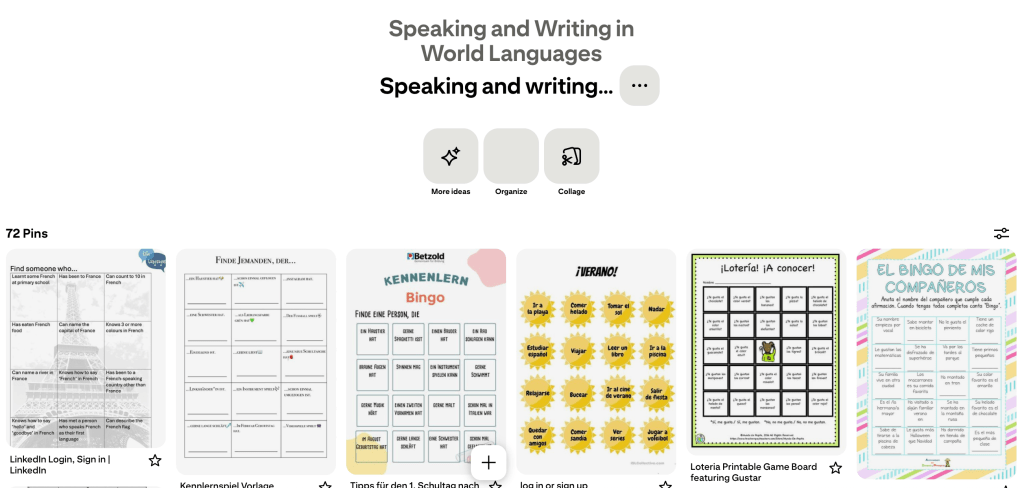
4. Finally, implement game-like, informal tasks for students to practice having interpersonal conversations. Strategies like Find Someone Who/Human Bingo, Speed Friending, Conversation Jenga, and Chat Stations can build student comfort in the interpersonal mode.

You can find lots of examples of those and similar strategies on this Pinterest board: https://www.pinterest.com/grahnforlang/speaking-and-writing-in-world-languages/speaking-and-writing-games/
Which strategy/strategies work for you? Which strategy will you try?

A Ticket Out the Door

Image

Many teachers struggle with closure.  It’s always a challenge to stop the lesson in time at the end of the period to sum up the day’s learning and reflect on whether or not we have achieved our desired outcomes.  One powerful strategy for gathering data about student learning at the end of a learning episode is the exit ticket.  An exit ticket gives the teacher formative data about where students are in their learning and should inform choices I make as a teacher about subsequent lesson plans.

Here are some great Exit Ticket templates you can use:

Click to access exitslips.pdf

And here is a Pinterest board devoted to the topic:

But, remember, an exit ticket does not have to be fancy and photocopied.  It can be a slip of paper or index card.  What matters most is:  will the questions you are asking provide you with the data you need to drive your instructional decision making?

We often ask questions on exit tickets that are too open ended or general.  Craft your questions to get at the most important learning: What will students know, understand, and be able to do?

Here is a list of Exit Ticket prompts I’ve begun to accumulate that are grouped by levels of Bloom’s taxonomy and more:

http://letthedatabeyourguide.wikispaces.com/Exit+Slip+Prompts

So, now I have the Exit Ticket data… what do I do with it?

Some examples of ways a teacher might respond to Exit Ticket data might be:

what the data says > how I might respond to it

  • all students met the objective > move on with the curriculum
  • most students have not met the objective >  plan a follow up activity using a different modality
  • some students met the objective, some partially met it, some are still struggling with it > sort the exit tickets to create flexible groups with tiered activities 

Exit tickets are just one way to collect formative data from our students and can provide direction for teachers on their lesson planning and their choices for instructional strategies.

It’s all about choices

Over the last several years, I’ve been doing a lot of work in the areas of student engagement and differentiated instruction.  Once aspect that stands out in both areas is the power of student choice.  According to Kanevsky and Keighley, in their article entitled “To Produce or Not to Produce: Understanding Boredom and the Honor of Underachievement” (2003), choice ranks among the 5 characteristics of an optimal learning environment that students seek along with the aspects of control, challenge, complexity and caring.  Choices are motivating to most people and we often make choices based on our personal preferences.

In the world of differentiation, choice also plays center stage and no other strategy illustrates this more than Choice Boards (also called Learning Menus, Think-Tac-Toes).  Choice boards offer a menu of options for students that can vary in content, process, or product.  They are most often constructed with varied learning styles and interests in mind.  Choice boards can even be tiered so that advanced learners are steered toward more challenging choices and struggling learners toward more scaffolded choices.

Here is a link to my wiki called Dare to Differentiate where you will find a plethora of examples of choice boards in various formats (one of my favorites is the dinner menu) for various subject areas and levels.  Also check out a new type of choice board I’ve recently found called the 2-5-8.  On the wikipage, I have also linked to or uploaded examples of rubrics for choice boards along with multimedia examples of ways to deepen your knowledge on the topic.

Image

Student Engagement: A Hot Topic

It seems everywhere you look, student engagement is a hot topic.  Engaging students in learning in the 21st century is very different from the way we engaged students in the past.  We know that many students are “cooperating” and “complying” in our classrooms, and some are downright angry about how disengaged they are.

If you are interested in exploring the topic of Student Engagement, I would like to direct you to a wiki I created called “Let’s Get Engaged.”  On that wiki, I have accumulated a considerable amount of resources on topics relating to student engagement, originally based on a multi-session workshop series.

On the page called “What is student engagement?,” I include a variety of resources in multimedia on the topic.  One of my “go-to” resources on the topic is the Schlechty Center.  You may know Phil Schlechty from his popular book, Working on the Work.  Schlechty describes several levels of engagement:

  • engagement
  • strategic compliance
  • ritual compliance
  • retreatism
  • rebellion

For a pdf description of the levels of engagement, click here.

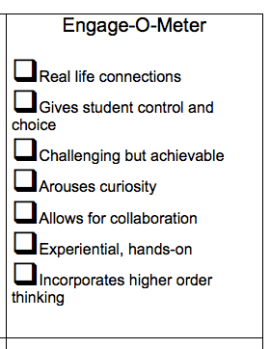
I have created a tool I call the “Engage-O-Meter” for teachers to use when reflecting on activities they plan for their students.  No one activity is likely to meet all of the qualities of engagement.  When teachers try out a new activity with a class that students do not seem to engage in, the Engage-O-Meter can give some direction to the teacher as to how the activity might be re-engineered to increase student engagement.  Here is that tool:

Image

An important point of discussion is the difference between engagement and entertainment.  Do I have to wear a clown nose and juggle to get my students to engage?  Not at all.  Quite simply put, entertainment is what the teacher is doing, engagement is what the students are doing.  Engaging with each other, engaging with the content, engaging in discussions with the teacher.  How do your lessons measure up on the “Engage-O-Meter?”