Learning centers allow students to work independently with content they have learned in the various skills areas: listening, reading, writing, and speaking. Centers also provide the opportunity to students to experience tasks that are at varying challenge levels while interacting with authentic text.
Skill-based centers allow students to put vocabulary words and grammar concepts into practice through guided reading, speaking, listening and writing activities. Centers allow students to work either independently or collaboratively with their peers, and also facilitate more meaningful one-on-one time with their teacher.
Why implement learning centers?
Increased student motivation
Meaningful learning opportunities
Fosters independence
Challenge advanced learners and heritage speakers
Students working independently on activities that may have otherwise been teacher-led
They are fun!
Steps to thinking through learning centers
Gather examples of authentic text on the theme of your choice to be used at centers as enrichment at the end of the unit.
video
infographic
poster
article
visual
commercial
2. Think about how each center might focus in one skill (listening, speaking, reading, writing)
3. Consider how students will capture their learning
Graphic organizers
Journal entries
Recordings
Photos
Notes page where students accumulate information
4. What will the follow up activity look like?
Group discussion
Speaking or writing performance
Jigsaw sharing
Tips for planning and managing centers
Practice each center as a whole group
Model use of center materials
Have generic directions for each center type and switch out content
For small spaces, centers move not students
For large classes, duplicate centers
“Ask three before me” strategy
Red, Yellow, and Green stoplight
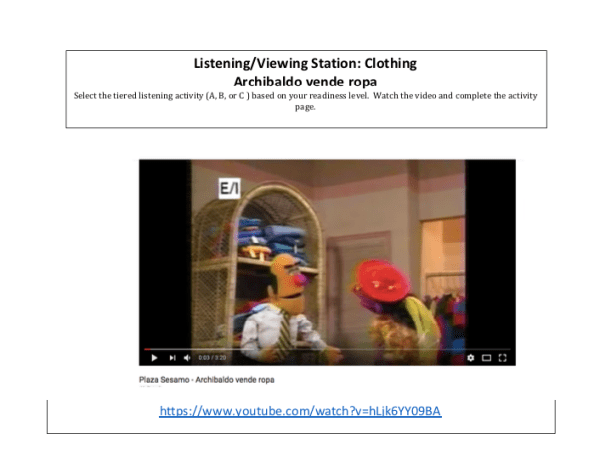
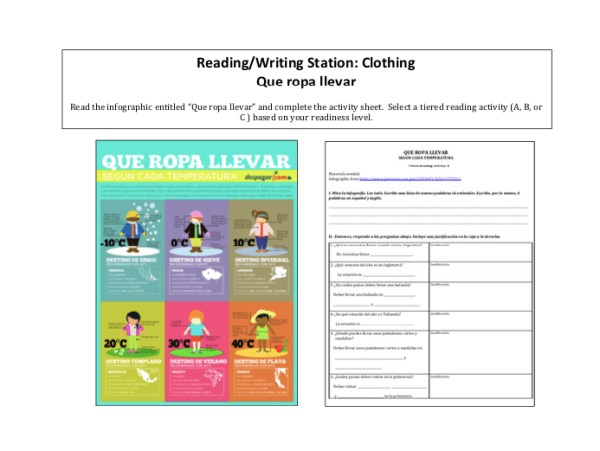
Example of learning centers for novice-level Spanish class on the theme of clothing:
Music is a universal language. Using authentic musical selections with language learners can be very motivating to students and a friendly way for students to hone their listening skills. Songs lyrics can be presented in written format, as an audio clip or as a music video (sometimes with subtitles). And, at times, students may be familiar with the artists.
Why use music as authentic text in the language classroom?
Includes repetition
Reinforces pronunciation
Shows language structures in context
Connects to culture, history, current events
Can be used as a classroom management strategy
Improves listening skills
Motivates students’ interest in the target language
Reinforces grammar and syntax
Encourages creative thought in the target language
Here are some examples of lesson activities you might use as processes for interpreting songs:
Alternate Title: Invent a new title for the song.
Alternate Verses: Given every other verse of the song, imagine the missing verses.
Before and After: Imagine what happened before and after action(s) in song.
Category Lists: Place words heard in specified categories. Variation: Given lyrics, read and place words in categories.
Chronological Order: Given a list of actions in song, decide probable order of occurrence. Listen to verify correctness.
Cover Design: Draw a CD cover to represent theme in song. Variation: Given a CD title, imagine the cover. Cover Speculation: Make conjectures based on CD cover.
Dialogue Adaptation: Adapt song to a dialogue.
Figures of Speech: Locate similes and metaphors in lyrics; discuss.
Four Corners: (1) After hearing song, go to designated corner of room (“love,” “like,” “don’t like,” “hate”) and discuss impressions. (2) Line up to show degree of like/dislike for song; discuss. (3) Rotate partners in inside-outside circles to share opinions about song.
Grammar Recognition: Raise hand/card or stand when you hear a selected grammatical feature in song (specific tense, gender, subjunctive, etc.).
Guess the Title: Listen to song and try to guess title. Imitate the Songwriter: Write a new song on the same topic or change original lyrics.
Incorrect Lyrics: Correct lyrics as you listen to song (listen for extraneous words or substitutions).
Key Words: Take word card or picture and stand when/if you hear your word in song. Variation: Given a list of possible words, check off if you hear a word in song.
Letters: Write a letter to the singer.
Lyrics Modification: Substitute other logical words for underlined words in song.
Motivation: Speculate about reasons for writing song.
Name That Word: When music stops before end of song, tell last word sung. Variation: Predict next word.
Predictions: Before hearing song, predict which words might logically fit in lyric blanks or which words would rhyme.
Ratings: Listen to snippets of songs to rate/compare.
Stories: Narrate or write out story from song. Variations: (1) Retell from another person’s point of view. (2) Write as a newspaper article.
Title Associations: Given song title, brainstorm list of words you might expect to hear in song; check off list as you listen.
Video Speculation: Imagine video of song.
Word Search: Given list of words, listen for synonyms/antonyms in lyrics.
Examples of tasks using music in multiple communicative modes
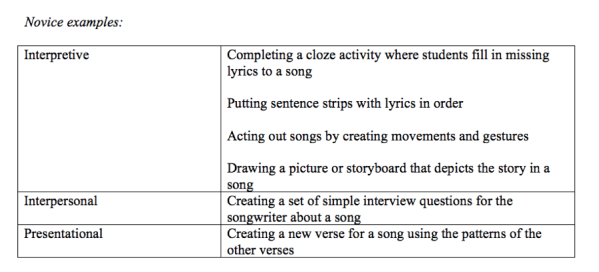
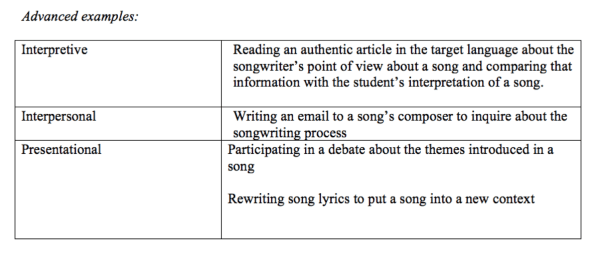
Songs not only provide practice in the interpretive mode for students, but can also serve as a springboard to interpersonal and presentational tasks.
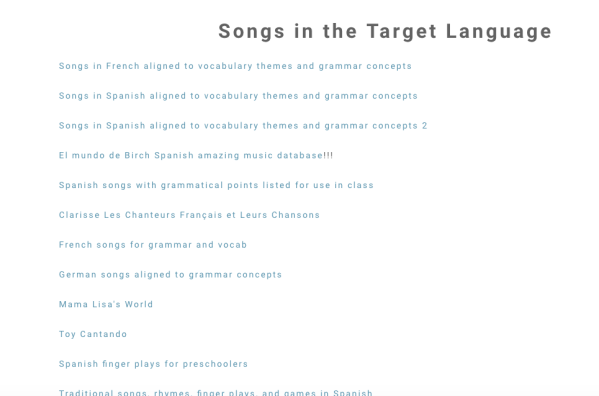
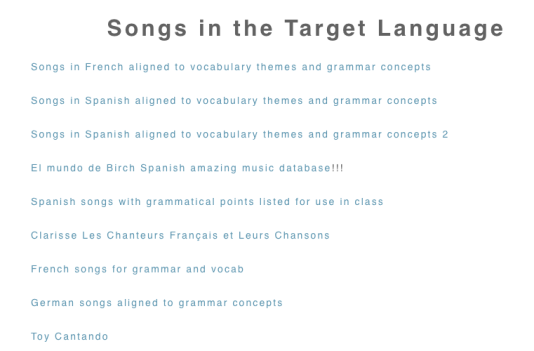
I invite you to visit my website where on the page entitled “Authentic Resources,” you will find multiple links for songs in the target language, often aligned to vocabulary and grammar points:
Many of our language colleagues have aligned popular songs in the target language to grammatical structures that they demonstrate in context and have generously shared those lists/databases with the rest of us.
In a proficiency-based classroom, students are assessed using real world tasks that allow them to demonstrate their language skills through performances. Giving students real world tasks comes as close as possible to an actual situation language learners might encounter with a native speaker in the target language.
Within the task, students interact with authentic text to practice interpretive skills and to add ideas for students to use in their final product, whether it be through speaking or writing.
Performance vs. Proficiency
When considering creating performance assessments for students, it is important to understand the difference between performance and proficiency. In essence, students have been “frontloaded” with the language they need for a performance assessment. The assessment is typically given after having explored a particular topic or theme which the students have been practicing.
Proficiency is measured when a student reacts to a prompt that may not be based on a recent topic covered in class. Students access language they need from their previous experiences and what they know about how language works to complete the task.
Performance assessments can range from focused on a single mode or involving integrated modes. Essential elements include: learning target (can-do statements), proficiency target, proficiency-based rubric, instructions to the student, and a scenario.
Performance toward proficiency is measured by using proficiency-based rubrics. Those rubrics may have criteria on which the student performance or product is measured such as vocabulary, language control, comprehensibility, complexity, etc. Here is an example below:
You can find additional examples of rubrics at this link:
Selecting the authentic text
Find an authentic text that is aligned to the unit theme, at the appropriate level for students’ age and expected proficiency level, and is interesting to students. The text might be in the form of a quote, an infographic, or a short video or audio clip.
Offering choices in the authentic text is learner-friendly and gives students a sense of control in the task.
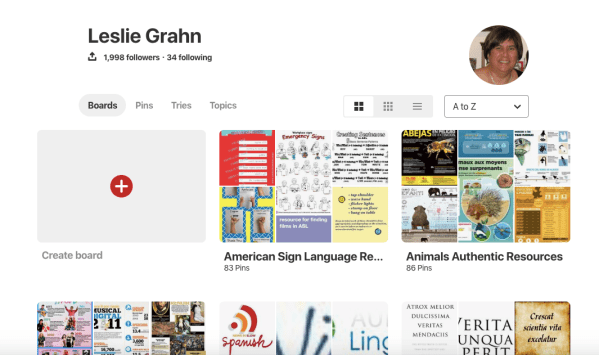
I invite you to visit my Pinterest boards which are organized by themes to select authentic resources for your performance assessments:
Developing a scenario
When creating scenarios for performance tasks, consider the following:
real life situations that connect with the authentic text
opened-ended
interesting to students
appropriate to students’ age and proficiency level
Here are some examples of possible performance task authentic texts and scenarios;
Novice Mid/Novice High:
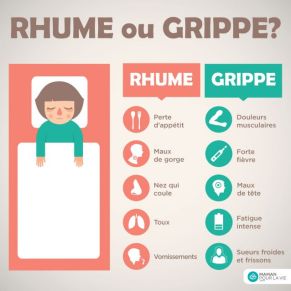
Scenario: You’re on vacation with your family in Paris. After feeling a little off yesterday, you woke up feeling horrible. You think you have a cold, because you have a headache, a sore throat and you’ve been coughing non-stop. You need medicine! You decide to go to a nearby pharmacy. The pharmacist asks you to explain how you feel and what you need. Describe how you feel to the pharmacist. Use your notes from the infographics.
Authentic Text: Select one of the infographics below to take notes on what the symptoms of cold and flu are:
When creating your speaking or writing product/performance, you should consider including:
That you are on vacation with your family
How you felt yesterday
How you feel today
Ask if the pharmacist has anything for the pain
Tell what you need (medicine, syrup/pill)
Ask how much the medicine is
Any other information that the pharmacist would find helpful.
Novice High/Intermediate Low
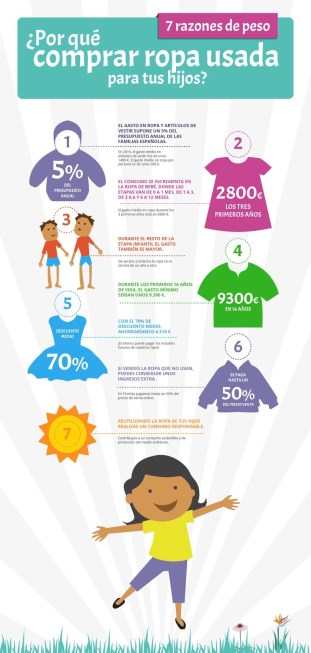
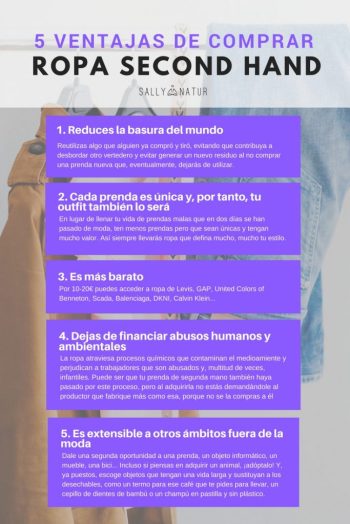
Scenario: You have been going through your closet and you know that you need to get rid of a few things. The items are still in great condition, so you decide to put two outfits on eBay to sell. In order to reach more potential buyers, you have decided to create your post in Spanish. You also want to include in your post reasons why buying second hand clothing is environmentally friendly.
Authentic text: Select one of the infographics below to take notes on why buying second hand clothing is earth-friendly.
When creating your speaking or writing product/performance, consider including:
A greeting
Two outfits you want to sell
Description of the outfit
Brand, sizes, colors, fit of each item of clothing
Price you would like for the outfit
Method of payment you will accept
Reasons why buying second hand clothing is green
Feel free to include any other relevant information in Spanish.
Supporting students through performance tasks
Students may be very anxious and self-conscious about performance assessments. Struggling learners may feel unprepared, unsure, are afraid to take risks, and do not feel skilled at the content. One solution may be providing graphic organizers for student to use to take notes from the authentic text and to organize their thoughts and brainstorm language they want to use to express their ideas.
Here is a link to a Powerpoint with multiple generic graphic organizers to use for performance tasks.
Preparing students for performance assessments
Before having students complete performance assessments in a high stakes setting, here are some tips on preparing them for the experience:
Model the process using think alouds
Analyze models/samples
Plan sentence combining practice
Practice with authentic text
Practice using graphic organizers
Practice speaking and writing in low stakes settings using rubrics
Having students peer evaluate and self evaluate using rubrics
We know that the ACTFL Core Practices encourage us to use authentic resources as much as possible in our teaching.
We also know that for each thematic unit we teach, we would ideally like to have a toolbox full of authentic resources for each that consists of a variety of texts and media that will
be appealing to our learners
expose them to a variety of text types
work for guided and independent activities and assessments, and other aspects of our lessons.
How do we find and curate all of the authentic resources we’d like to use in our lessons for a thematic unit?
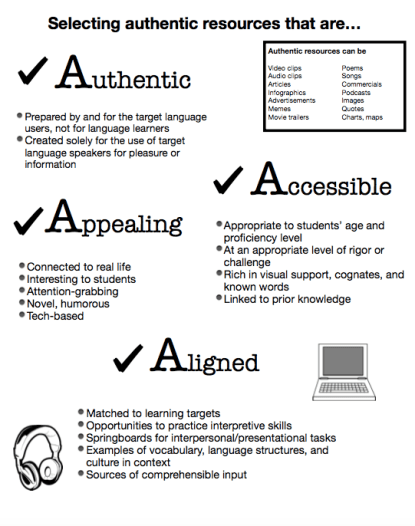
When you are gathering authentic resources for any thematic unit, there are several things to keep in mind. In my blog post from September 16, 2017, “How do I select authentic resources for my language classroom?” I offered a tool for guiding your selection of authentic resources (which can be downloaded by clicking on the image below):
Let’s begin by considering the variety of authentic resources that may exist around a particular theme.
Pinterest is a good place to start. On Pinterest, you will find many language colleagues have built boards around themes. As I shared in my post, “How do I find authentic resources for my language classroom?” (posted on 9/8/17 ), there are “Pinners” you can follow on Pinterest whose boards are arranged around themes you teach. Some of my recommendations include:
I have created over 100 Pinterest boards on a variety of topics for multiple languages. I have attempted to curate all of the authentic resources so that they are appropriate to use with students, but the rule of thumb about using any new resource with your students is:
Preview! Preview! Preview!
Please feel free to peruse the boards that align to your units. Click on the image below to go to my webpage where each of the themes is clickable:
What if you want to collect your own set of authentic resources for a particular theme?
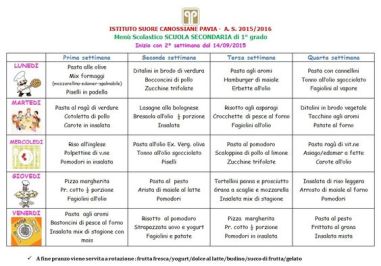
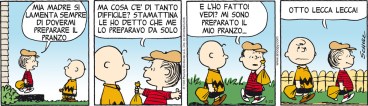
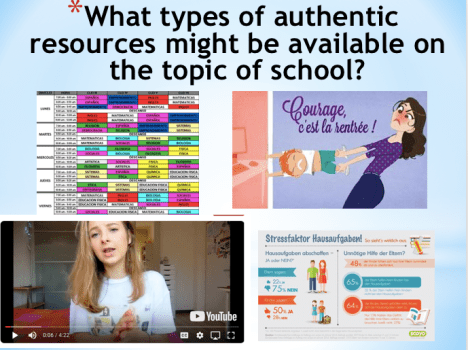
Let’s use the example of a thematic unit about school and the subtopic is school lunches. Some examples of authentic resources gathered on that subtopic might be:
Poster (French):
Meme (Spanish):
Weekly menu (Italian):
Infographic (German): .
Infographic (Portuguese) .
Brochure (Spanish):
Video (German):
Cartoon (Italian):
Animated cartoon (French):
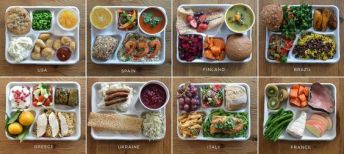
Photo (lunches from around the world)
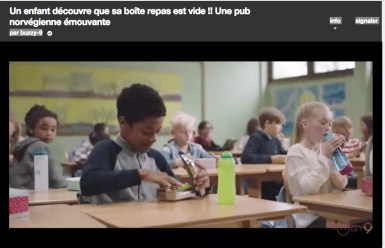
Commercial (French):
For more authentic resources on the topic of school lunches for multiple languages, visit my Pinterest board:
Once you have gathered lots of examples of authentic text for a particular theme or unit, consider how you will implement each of them. Think of the list of questions below as categories under which you can sort the authentic resources you have gathered:
Which authentic resources will you use as lesson hooks that arehigh interestto your students?
Which authentic resources will you group together of varying difficulty levels to provide challenge for all learners in the form of tiered textor tiered tasks?
Which authentic resources will students use as a basis for interpersonal tasks? for presentational tasks?
Because of the highly visual nature of many authentic resources, they can easily be used to introduce and reinforce new vocabulary because they provide a context for learning the words and phrases. Using authentic resources for the input phase of the lesson adds interest for the learners and injects real world connections.
Infographics
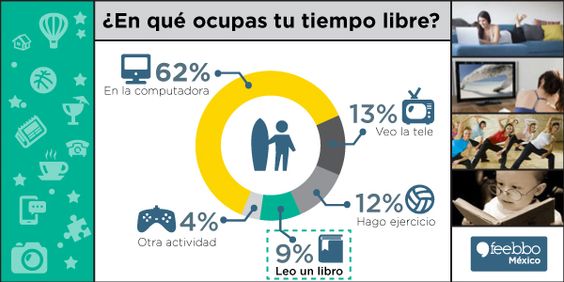
Infographics that illustrate results from a survey often provide visuals for the theme of the survey and give the context of what peoples’ preferences are. They offer the opportunity for students to make predictions about survey results and compare and contrast them with their own opinions.
Here is an example in Spanish about sports preferences around the world:
Here’s one for leisure time activities in French:
And one for favorite foods in German:
And one for most ideal occupations in French:
And one for most trusted occupations in German:
And one for Italian for which region of Italy offers the best job opportunities:
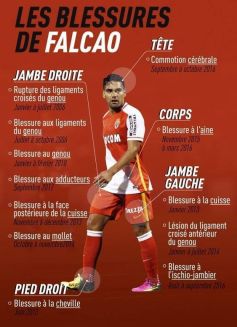
Instead of learning about or practicing vocabulary related to body parts by looking at a drawing of a nondescript person, think about how much more engaging it will be for students to talk about body parts in the context of a famous soccer player’s injuries.
Some examples of strategies for introducing and reinforcing thematic vocabulary through infographics include:
Initially covering up the labels on an infographic as the teacher introduces the new vocabulary and then revealing them while checking for understanding.
Students have a version of the infographic with blanks where the vocabulary words are and a word bank with the new words. As the teacher introduces the new vocabulary, students write the appropriate words and phrases into the blanks.
Students are given a version of the infographic in pieces. They assemble the “puzzle” as the vocabulary is introduced.
More examples:
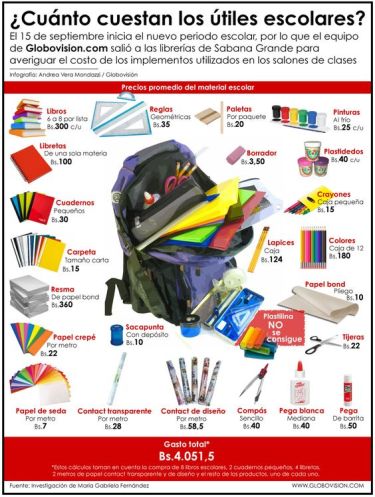
A. School supplies in the context of shopping for back to school (Spanish):
B. Food in the context of what your pet can and cannot eat (Spanish):
C. Clothing in the context of packing a suitcase (Spanish):
D. Modes of transportation in the context of how people get to work (French and Spanish):
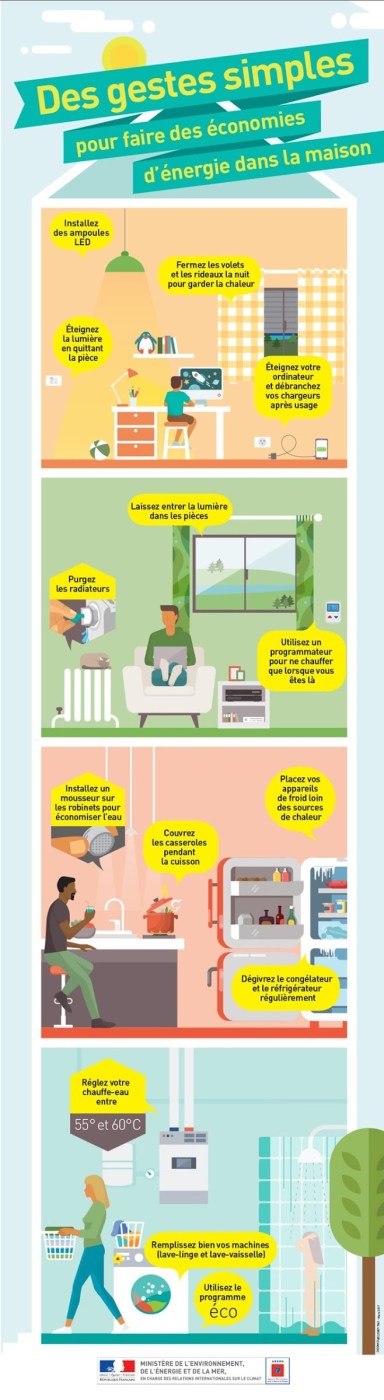
E. Rooms of the house in the context of saving energy in your home (French):
I invite you to visit my Pinterest boards, many of which are organized by topic, to find infographics aligned to your vocabulary themes for introduction and for reinforcement:
Using authentic text with young language learners can present multiple challenges. Students in Pre-kindergarten, Kindergarten and the primary grades are often not yet literate in their first language. As a result, using authentic resources that are heavy in written text are not appropriate to use with most young learners.
Picture books
Early language learners can benefit from being read to by the teacher. Picture books provide visuals that support the students’ understanding. Through picture books, teachers can model ways to derive meaning from text using reading strategies such as guessing meaning using pictures and guessing words that look or sound like their English equivalent. In addition, young language learners can interact with websites and apps that offer picture books that, in some cases, can be read to students. Some examples include:
Because songs, rhymes, and poems often have repetition and rhyming words, they are very user-friendly for young language learners. Adding gestures to songs, rhymes, and poems will assist students in comprehension of the text.
One source for target language songs and rhymes for multiple languages is called Mama Lisa’s World:
On YouTube, you can find children’s songs in the target language (but can be difficult to verify as authentic) which contain a video component, like the following example:
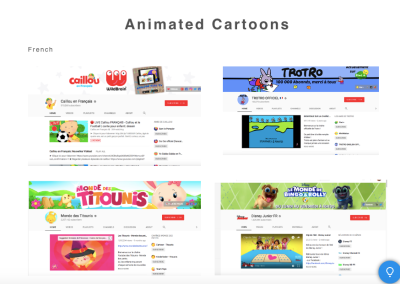
At the very heart of the raison d’être of cartoons is to engage young children. Cartoons in any language appeal to young language learners. There are many target language cartoons available online through YouTube and can be aligned to thematic units such as family, celebrations, travel, and making friends.
Click the image below to visit my webpage where I have linked several cartoon series in various languages.
Visuals for Speaking and Writing
Although not all visuals can be verified as “authentic text,” there are visuals available that have target language contexts. The Pinterest board linked below offers a selection of visuals that can be used for practicing the interpretive mode, leading to both speaking and writing prompts.
Infographics
The best infographics to use with young language learners are those that are highly visual balanced with minimal written text. Here is a link to my Pinterest board called “Authentic Text for Young Language Learners.”
Fine Art
Interpreting pieces of art can be the basis for speaking and writing prompts for young language learners. Not only are visuals a type of text, but by being fine art, a cultural context is added. When students describe a painting, they can talk about the colors, the items in the picture, their location in relationship to one another (prepositions of location), the time of day, weather, describing the people in the painting, etc.
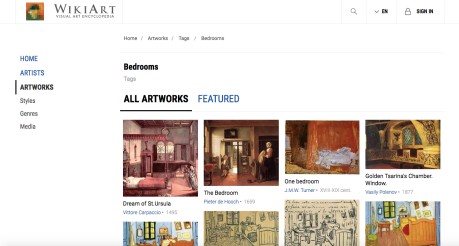
A great example is VanGogh’s Bedroom at Arles:
Students can describe the colors they see, the items in the room, and their position in the room.
The student learning can be extended by then learning about the artist.
To add to your resource toolbox, there are coloring pages online (free download) for famous artwork:
For more examples of artwork relating to the bedroom (house) click the image below:
Many of the above mentioned strategies allow students to use an inductive approach to figure out the “why” and “how” of grammar in context. Some have more structured protocols than others. Which one you choose depends on your students, the particular grammar point you want to highlight, and what works best for your teaching.
For this post, let’s turn our attention to examples of how authentic resources that might be used to teach grammar in context, thus combining two of the core practices.
The most natural way for students to gain an understanding of grammar in the target language is for them to see it being used in context. Context carries meaning for students in lieu of learning “about” grammar in isolation, often in English.
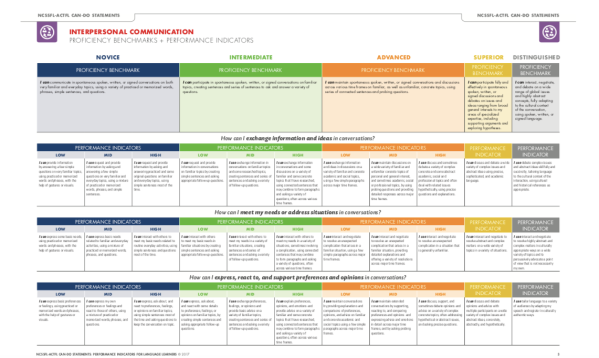
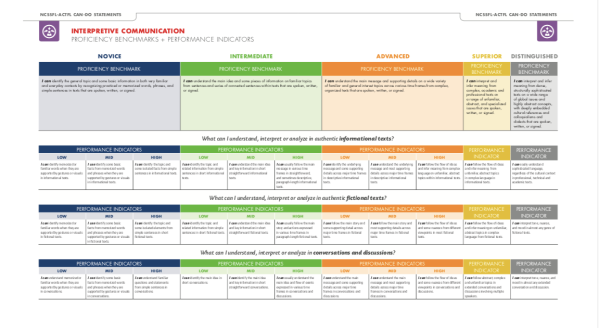
In no way do the Core Practices imply that grammar or structure are no longer important to language learning. Looking closely at the NCSSFL-ACTFL Can-Do Statements, beginning at the Intermediate High proficiency level (in the case below for interpersonal communication), students must be able to exchange information and interact across various time frames. At those levels, language learners must have structural understanding to be able to communicate in a variety of tenses.
Memes and quotes
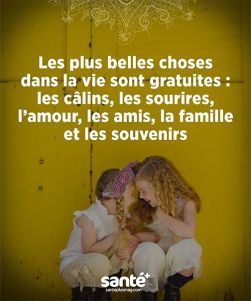
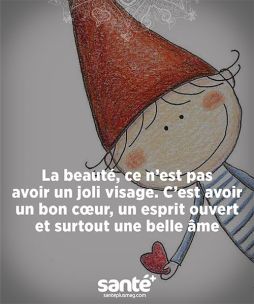
A great place to start with teaching grammar as a concept and using it in context through authentic resources is to use memes and quotes.
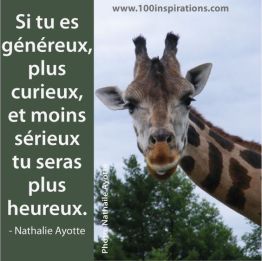
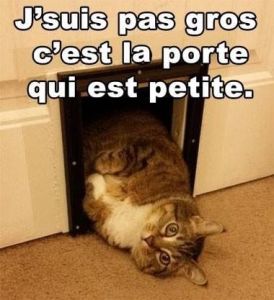
Memes (although they cannot always be verified as authentic) are examples of grammar in context mixed with humor. Many of them involve cats, dogs, and characters from television and movies.
A series of memes that are examples of a particular grammar point can be shown to language learners to have them draw conclusions about how that particular structure works.
Here are some examples below for adjectives in French:
One way to approach this task is to give small groups of students one meme. Students analyze the meme first for meaning. What is the meme trying to say? Students use the visuals, cognates, words they already know, and words that may be related to ones they know to help them unlock the meaning. The teacher circulates in the classroom and assists students with guessing the meaning of words with which they are unfamiliar using target language examples, circumlocution, and visuals, etc. to reinforce their meaning.
Then, students’ attention is directed to the adjectives in each quote/saying and the students draw conclusions about:
the gender of the nouns being described
the position of the adjectives (before or after the noun)
the endings on the adjectives and what they say about the nouns they are describing.
The teacher might follow up with asking students to change the nouns in the memes. For example, in the meme with the giraffe, students can rework the quote to include a noun that is feminine, plural, etc.
The small groups of students may then be asked to create a meme of their own using ideas from the examples.
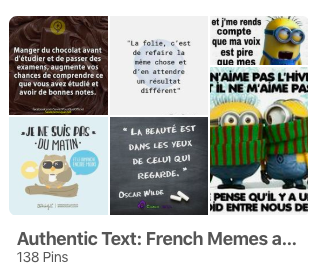
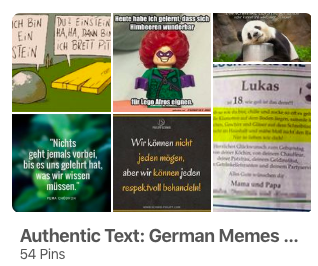
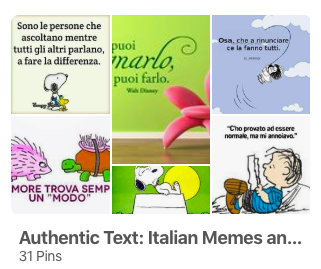
Visit my Pinterest page to see collections of memes and quotes for multiple languages or click on the images below for particular languages (French, German, Italian, and Spanish):
Tweets and other social media posts
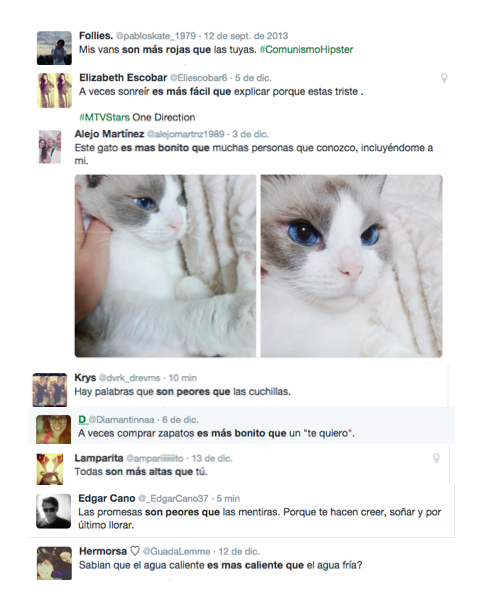
The tweets below are authentic social media posts that all demonstrate the comparative in Spanish. The teacher searched for them in Twitter by inputting phrases like “más que” and “menos que.” Consider how a teacher might initially have students interact with the tweets as an interpretive task (deriving meaning from them) and then use the same tweets to examine how the comparative works in Spanish. Students may be asked to highlight or circle the items/ideas being compared in each sentence and draw conclusions about what determined the ending of each adjective.
Poems and song lyrics
Poems and song lyrics are types of authentic text that are very friendly to teaching grammar as a concept in context. Many of our language colleagues have aligned popular songs and famous poems in the target language to grammatical structures that they demonstrate in context and have generously shared those lists/databases with the rest of us.
The entire poem is embedded with examples of the passé composé in context:
Example in practice:
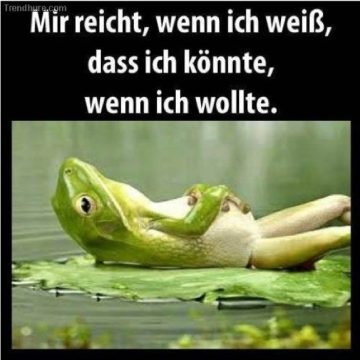
In an intermediate German class, the teacher shows a meme “It’s enough for me that I know that I could if I wanted to” to gain students’ attention and to spark a review of the use of the subjunctive in German. Students are asked to brainstorm descriptors of the frog (confident, lazy, smart, etc.). The teacher asks the students to tell why they chose the various descriptors. If necessary, the teacher models an example (I think he is _____ because _____.)
The teacher draws the students’ attention to the verbs in the meme and their tenses. She tells them that they will be listening to a song with a similar title and theme, “Wenn ich könnte wie ich wollte,” by Howard Carpendale.
The students are given a cloze activity with the lyrics to the song where all of the subjunctive forms (and other phrases) are removed and the students fill in the verb forms. As they listen to the song, they check their answers and fill in other missing phrases. The students share their answers in small groups and then listen a final time with all lyrics complete.
The teacher then provides a chart where the students fill in the present tense, imperfect tense, and the subjunctive verb forms (the verbs in bold all appear in the song):
As an extension activity, students are led through a guided writing task where they plan, peer edit, and write the final draft of a journal entry entitled “If I could, I would…”
Authentic resources are created by and for the target language users either for information or entertainment. They are texts that students can read, listen to, or view in the target language. Much attention is paid to written authentic text.
For this post, let’s turn our attention to building students’ interpretive skills with authentic text for listening and viewing.
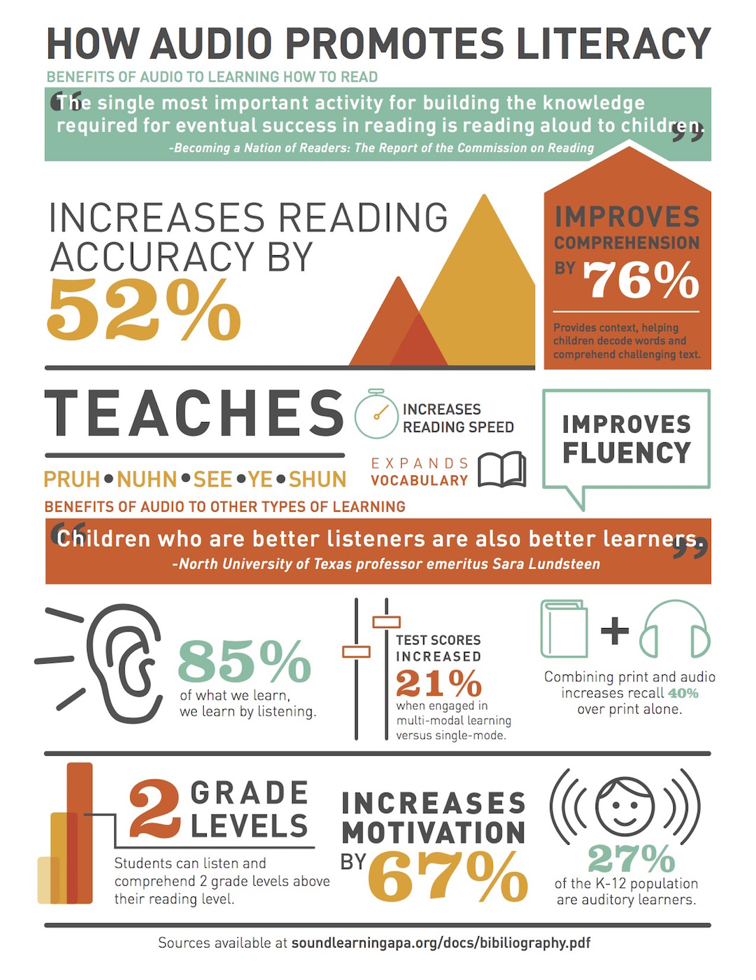
As indicated by the infographic below, listening has many benefits which include increasing literacy, fluency and motivation.
When considering having students listen or view authentic text, we must first anchor ourselves in the NCSSFL-ACTFL Can-Do Statements that describe what students can do in the Interpretive Mode at the various proficiency levels.
Novices can: identify words and phrases, some isolated facts, and the topic or gist of an authentic text that is composed of simple sentences that is listened to or viewed.
Students at the intermediate level can: identify the main idea and some details from short straightforward authentic text and conversations.
Here are some examples of novice-level listening/viewing activities:
Spanish- During a unit on the theme of school, students listen to and watch a 30 second commercial about back to school sales at Arrocha, a store in Panama:
During their listening/viewing, students are asked to:
circle all of the words/phrases they hear in the commercial based on a word cloud of words created on Wordle or Tagxedo
circle each vocabulary word/phrase they hear and draw a line to the backpack
complete a cloze activity with the commercial transcript.
2. French- During a unit on the theme of describing people and things, students listen to and watch a Coca Cola commercial called “Du bonheur pour tous.”
While they listen to and view the commercial, in addition to bullets one and three listed above (circling key words in a word cloud and doing a cloze activity using the transcript) an alternative activity might be:
Students are given two columns of adjectives/descriptors. As they listen to/watch the commercial they connect the opposites.
For links to authentic commercials in the target language, go to:
Or, go to my Pinterest boards that have target language commercials sorted by language:
Types of authentic text that might be listened to or viewed include:
commercials
podcasts
songs/music videos
video clips
movie trailers
news clip
live or recorded interviews
live or recorded performances
animated short films
fine art
photographs
The approach for teaching students how to listen to or view an authentic text (with audio) is very similar to that of teaching students how to read an authentic text. Students listen/view for words they know, words that sound like words they know (cognates), and figure out meaning of words based on context.
Students’ comprehension can be bolstered before listening or viewing (with audio) by using typical before reading strategies:
Students make predictions about the authentic text
Students brainstorm connections with and ideas and questions about the topic of the authentic text
Students list what they already know about the topic of the authentic resource
Similarly, students can use during reading strategies for listening and viewing (with audio) as well.
Students take notes about authentic text as they listen/view
Students record new vocabulary gained from the authentic text
Students use a graphic organizer to record ideas while listening/viewing
What makes listening and viewing very different from reading as an interpretive skill, is that the text (unless the transcript is provided or there are subtitles) is not visible to the student. To overcome this challenge (of not being able to see the words), students can be taught skills for capturing ideas they listen to through the use of a variety of strategies.
Supports and Scaffolds for Students During Listening and Viewing Tasks
Cloze activities
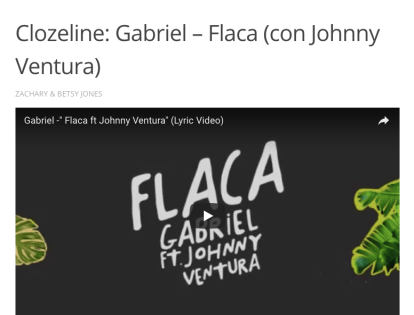
Cloze activities are those that use the script for a text with words or phrases omitted. The task of the student is to listen to the text and fill in the missing words and phrases. A great source for cloze activities for Spanish based on music is Zachary Jones’ website called Zambombazo. He calls the activities “Clozeline.”
Here’s an example:
Here’s a cloze activity example in French for the song by Gerald DePalmas called “Mon Coeur Ne Bat Plus.”:
Graphic Organizers
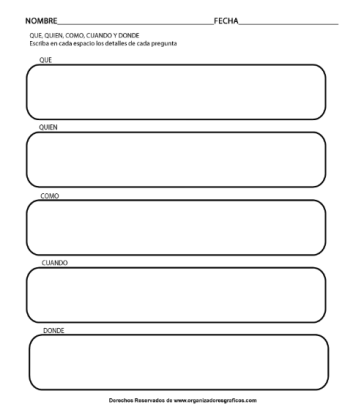
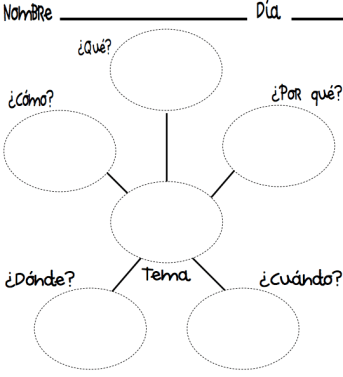
Graphic organizers assist students in capturing what they have heard/viewed and classify those ideas into topics/themes. A great example is a 5W’s (who, what, when, where, why) and 1H (how) graphic organizer. Here are some examples in Spanish below:
And here’s an example in French:
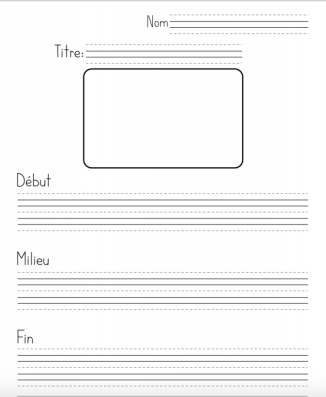
Or, the organizer might be where students record events from the text in sequence. Here is an example in French:
and one for Spanish:
For more examples of graphic organizers, click here
Visual Notetaking or “Sketchnoting”
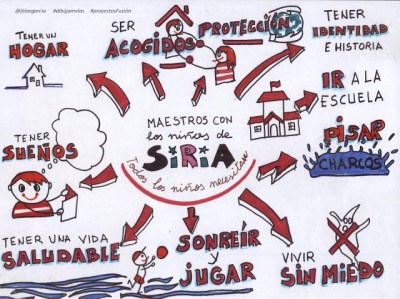
Visual notetaking or Sketchnoting is a strategy whereby students draw symbols and pictures to indicate their understanding of a text. The result is a visual version of the text that was listened to or viewed.
Here’s an example in Spanish:
For more on how to teach listening skills, explore the slideshow below:
Included in the examples of authentic text are visuals like photographs and fine art.
How do we teach students to interpret text like pictures?
Some strategies students can use when “reading a picture” are:
describe what they see (what is going on, who is doing what)
make connections with the visual
describe how the picture makes them feel
express an opinion
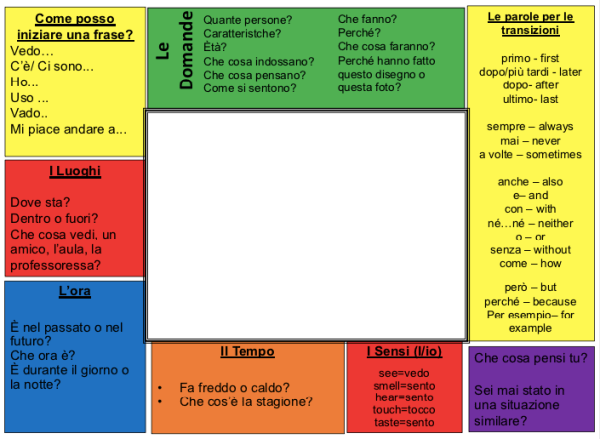
A great scaffold/support for students to practice how to interpret a picture is a “Picture Description Frame.” Here’s an example below for Italian. Students lay the “frame”(with the center cut out) over the picture and use the expressions around the perimeter of the frame to help them describe the visual either through speaking or writing.
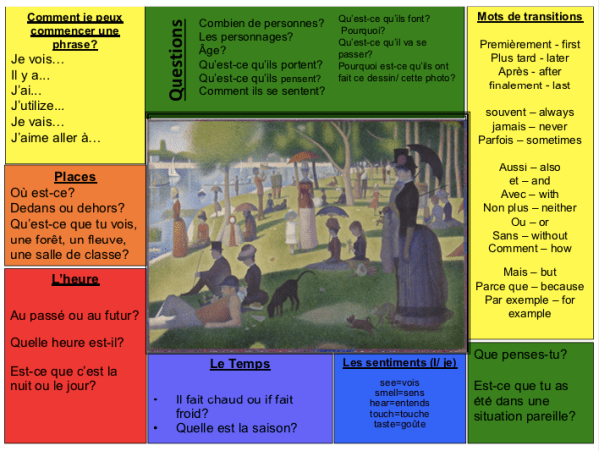
Here’s an example for French:
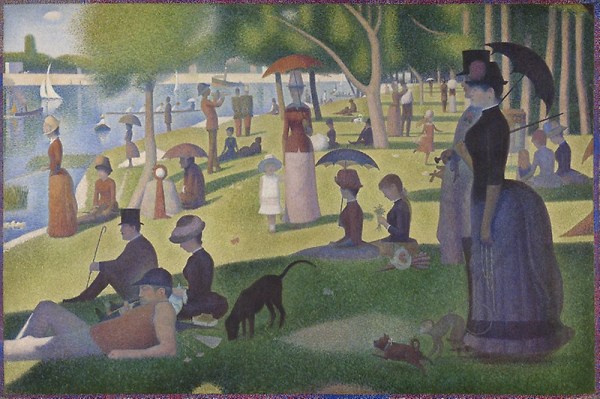
During a unit on leisure activities, students view the painting called “A Sunday Afternoon on the Island of La Grande Jatte” by Georges Seurat.
The students overlay their “description frames” onto the image.
Then, the students use the prompts around the frame to assist them with describing the picture either orally or in written format.
This tool and ones for other languages can be found at the link below by scrolling down to the bottom of the webpage:
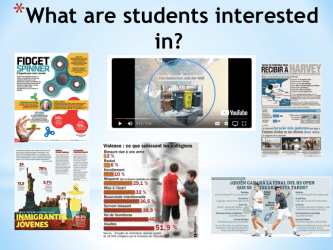
What do students in the target culture carry in their backpacks? (video in Italian)
More questions students may have:
Do the students have to wear uniforms?
What do they have for lunch?
What supplies do they need for school?
Do they use cellphones/technology in their schools?
Are their backpacks heavy like ours?
Do they have after school activities?
These questions provide a rich context for the “school unit” as the teacher plans tasks and activities for the daily lessons. In addition, students feel empowered that the teacher asks them about their interests and may be more engaged in class tasks because they feel that they have contributed to the plan.
FYI- For more authentic resources on the topic of “back to school” for French, German, Italian, Portuguese, Russian, and Spanish, go to:
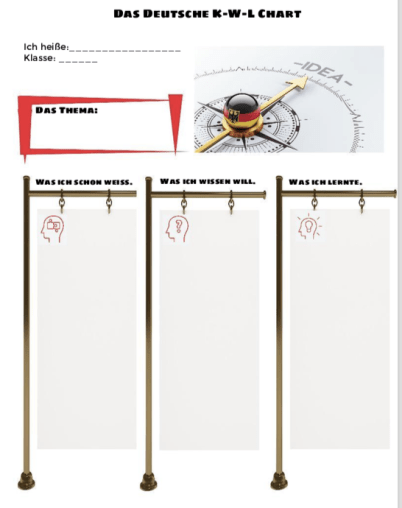
Implementing K-W-L Charts
K-W-L charts are a more graphic way to collect information from your students about their interests. K-W-L is a strategy developed by Donna Ogle (1986). It is set up in three columns:
“K”- What I know
“W”- What I’d like to learn
“L”- What I learned
What students write in the “K” column reveals what students already know about the topic. It may include vocabulary words, phrases, beliefs, and misconceptions. Teachers can use this information to recognize knowledge students bring to the topic and use that information as a starting point for the unit theme.
Student thinking recorded in the “W” (What I’d like to learn) column gives teachers information about how to craft lessons that will address students’ interests, and therefore should increase student motivation and engagement.
Here are some examples of K-W-L Graphic Organizers in Spanish, French, and German:
Using high interest authentic resources as lesson hooks
A lesson hook is another way of naming what Madeline Hunter referred to as the “anticipatory set.” It is the first thing students see and do when the lesson begins. The lesson hook has several purposes:
grab students’ attention
directly relate to the lesson objective/target
tap prior knowledge
reinforce previously learned material
connect or combine learning
extend or enrich learning
show grammar in context
add a cultural component
When selecting an authentic resource to act as a lesson hook with student interest in mind, consider using
humor/jokes
current events
novel visuals
The lesson hook authentic text can be used as a jumping off point to any number of learner-centered tasks like interpersonal exchanges or a free write. They can also begin a conversation about grammar and syntax in context.
Some examples:
Meme (in French)
Cartoon/comic strip (Spanish)
Commercial (in German):
Art:
Quote (in Chinese):
Example classroom scenario:
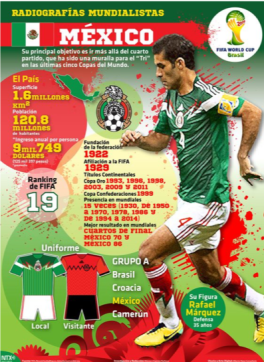
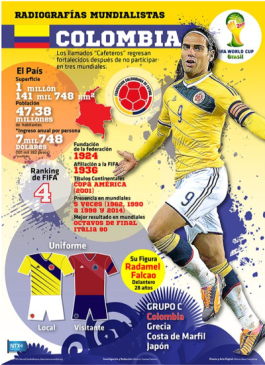
In a novice high/intermediate low level Spanish class, during the unit on leisure activities, the teacher has discovered that many students in the class are fans of FIFA and/or play on the school soccer teams. Guided by the interests of the students, the teacher shows two infographics from a Pinterest board called “Radiografías Mundialistas” to review with students how to express comparatives and superlatives in preparation for a performance assessment where students must compare and contrast two texts.
The teacher begins by asking yes/no and either/or questions about the infographics and then spirals up to who, what, when, where questions. Based on student performance, the teacher may elect to increase the rigor of questions by including how and why questions with students justifying their responses. She uses comprehensible input strategies to review key words in the target language such as:
the same as larger
as many ____ as smaller
more _____ than the most
less _____ than the least
better but
worse
The teacher then puts students into pairs. Each pair selects two countries’ soccer teams from the Pinterest board and read the information on the infographics for those teams (ex.Uruguay and Suiza). They work together to glean the similarities and differences between the countries and teams. The teacher provides them with a list of the expressions reviewed earlier in the lesson.
Each pair creates a quiz using Google Forms that consists of the two infographics, three true comparison statements about them, and two false ones. Classmates take each pair’s “quiz” through the Google Forms.
As students move across the proficiency continuum, a great goal to work toward is to have students conduct discussions in the target language about the authentic texts they have interpreted.
As is described in the NCSSFL-ACTFL Can-Do Statements, students work toward being able to participate in discussions once they reach the intermediate high proficiency level and beyond. It is important that we begin to build students’ skills early on in their language learning experience, beginning with highly scaffolded, simple discussions to more in-depth, spontaneous ones.
In the interpretive mode, beginning at the intermediate high proficiency level, it is expected that language learners can “understand the main message and some supporting details across major time frames in conversations and discussions.”
In the interpersonal mode, beginning at the advanced level, speakers “can maintain spontaneous spoken, written, or signed conversations and discussions across various time frames on familiar, as well as unfamiliar, concrete topics, using series of connected sentences and probing questions.”
So, how do we put novice language learners on the pathway toward being able to participate confidently in discussions in the target language?
From the novice level, students can participate in discussions in the target language about authentic texts they have interpreted if those experiences are:
well-modeled by the teacher
highly scaffolded
Types of discussions students might have include:
making decisions
solving problems
expressing opinions
creating a product
Scaffolds for discussion skills might include:
graphic organizers on which students have taken notes about the authentic text, ideally set up to assist them in the discussion. For example, if the intent of the discussion is for students to compare and contrast two ideas, a Venn diagram might be the most appropriate graphic organizer to use. Here’s an example of an organizer in Italian:
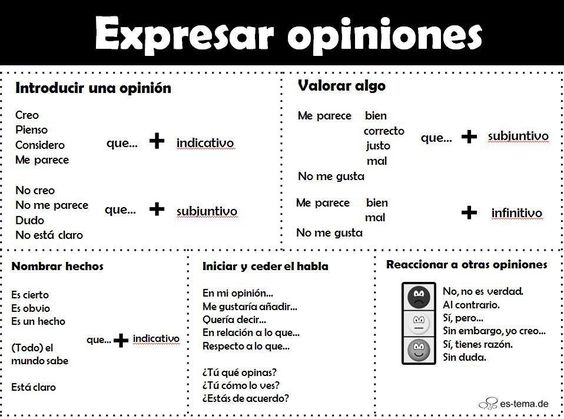
expressions lists that support students’ conversations. For example, if the purpose of the discussion is to express an opinion about the authentic text, sentence frames/starters would be provided. An example in French is below:
protocols for discussions: taking turns, using gambits or conversational fillers, building off of what group members have said, assigning group roles, etc.
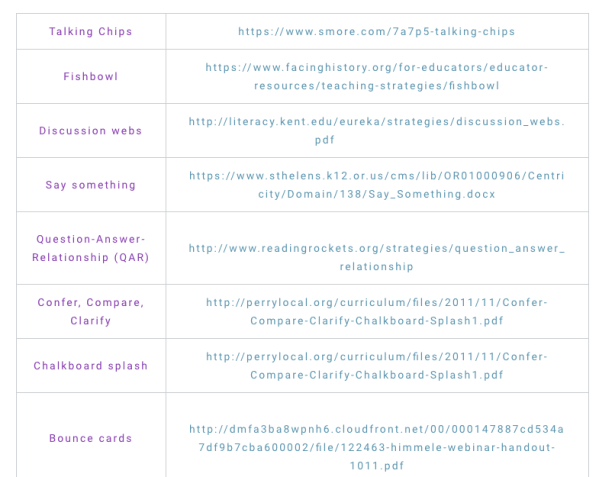
a routine or strategy that serves as a framework for the discussion. Click on the image below to explore a variety of discussion strategies.
Example classroom scenario:
In an intermediate level Spanish class, the teacher shows this quote by Pablo Neruda during a unit on Personal and Public Identities. The teacher asks students to write a summary statement in the target language about the quote.
Then, the teacher gives each small group one part of the quote:
Quien no viaja [someone who doesn’t travel]
Quien no lee [someone who doesn’t read]
Quien no escucha música [someone who doesn’t listen to music]
Students work in groups to discuss the benefits of traveling, reading, and listening to music and each student records their group’s ideas on a graphic organizer. When ready, students move to mixed groups to share their group’s ideas. They conduct a conversation with their classmates using the “Bounce” strategy in the target language. Additional ideas generated by the group are added to the graphic organizers.
As an extension, student groups are given the choice of:
Creating an infographic on the benefits of traveling, reading, listening to music, etc. using tech tools such as Piktochart











 .
.




































 passion4theprofession